
A rule set is the screening criteria you attach to a unit. It controls three things: which of the six checks are required, the income and affordability standard, and the screening fee, including who pays it. You can create a rule set once and reuse it across many units.
What a rule set defines
Required checks. You choose which of the six checks (identity, income, employment, credit, background, and eviction) a screening must include.
Affordability. You set the income standard used to evaluate whether the rent is affordable to the applicant. In the current version, affordability sums the income of the primary applicant and any co-applicant, then compares the combined income against the rent.
Fee. You set the screening fee and choose whether the applicant or the operator pays it. See Setting the screening fee and who pays it.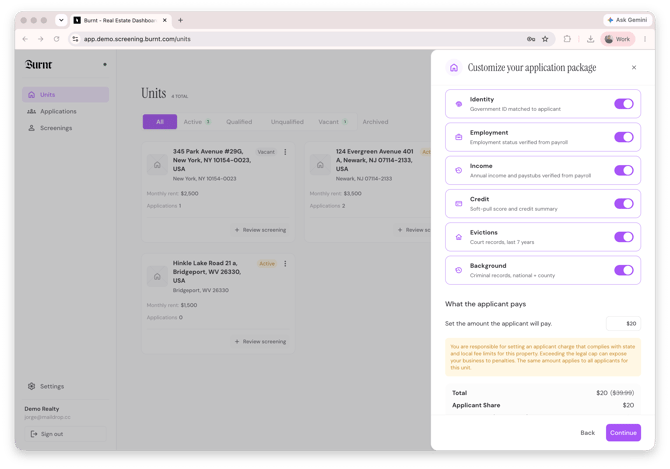
How and when criteria are applied
The fee and criteria are recorded onto the screening at the moment the screening is created. This means a screening always reflects the rule set as it stood when the applicant began, even if you change the rule set later. This preserves an accurate record of the criteria each applicant was evaluated against.
Next steps
- To build one, see How to create a rule set.
- To set the income standard, see Setting income and affordability criteria.